Monday, November 6, 2017

Achieving SDGs through sport – Episode 6 - Dr. Gilles Klein

Achieving SDGs through sport – Episode 6

Transform the world: Lausanne – Addis Ababa
  
Dr. Gilles Klein, 06 November 2017
   
Vevey

Lausanne - Addis Ababa. While in Lausanne for the seminar "Achieving the SDGs through sports" I was probably one of the rare guests to establish a rapprochement between these two cities. It is on this virtual journey that I want to invite you today. At first glance, nothing seems to connect them. One is the capital of Canton Vaud, Switzerland. It is located on the shores of Lake Geneva. Everything seems to inspire tranquility. The other is the capital of Ethiopia. It is a permanent building site as much noisy work is in progress. Hundreds of Chinese and Ethiopian workers are struggling throughout the week. It is located on a plateau at more than 2000 meters above sea level, making it the highest capital of Africa. To connect them, there is indeed this property owned by the last emperor of Ethiopia, Haile Selassie, said the Negus, on the shores of Lake Geneva, in Vevey[1]. Less anecdotally, it is a highly political mission that links the two cities. Both are emblematic places of geopolitics, diplomacy and multilateralism.

Pearl

Lausanne, nicknamed the pearl of Lake Geneva, has established itself as the capital of sports diplomacy since the beginning of the 20th century. On the pediments of public institutions, it proudly displays the title of Olympic Capital, because it is the seat of the International Olympic Committee (IOC) and fifty-five international sports federations. Former IOC President Juan Antonio Samaranch offered this title to the city so that the universal values of sport correspond to a particular territorial expression. It is therefore no coincidence that Lausanne hosted a seminar on October 5th, with the support of the Swiss authorities, which brought together major sports organizations to discuss the contribution of sport to the Sustainable Development Goals (SDGs) and the 2030 program of the United Nations.

Quai d’Ouchy

Seizing this opportunity, I made another visit to the Olympic Museum. Climbing the steps, and then in front of the statue of Pierre de Coubertin, reminded me of the journey that separated June 23, 1894 and September 13, 2017. The first date marked the creation of the IOC in Paris, the second of the attribution of the Games to the French capital in 2014, which the French in me could only rejoice about. The whole history of modern Olympism was between these two dates. If Samaranch had established Lausanne in the Olympic capital, it was indeed Coubertin himself who had chosen the neutrality of the capital of the Canton of Vaud, while the First World War was raging. The headquarters of the IOC have been there since 1915 on the shores of Lake Geneva. In 1968, the definitive seat was established at Vidy Castle[2], where the office of the president of this major institution is now located.

Torch

By observing some Chinese tourists posing in front of the French baron’s statue, I thought back to his initial wish, 1500 years after the Greek Games, to help build a peaceful world through sport by promoting communication, fair play and understanding between peoples. In 1894, Pierre de Coubertin breathed his aristocratic philosophy to the sports institution that had just been created. Utopian and humanist, he dreamed then of a universal peace. A peace that is favored by the sporting confrontation. A peace that imposes respect between competitors and between nations. On the eve of this visit to the Musée du Quai d'Ouchy, with more than a hundred colleagues from the sports sector on a global scale, we had come across the diversity of points of view and tried to build synergies between major sports organizations on how sport contributes to development and peace. In our way, we took up the torch of the Baron having taken care to rid us of the inequality of races and genres, the fascination with colonialism and the strong powers that presided over the Coubertinian philosophy.

Flower

Addis Ababa, a new flower in the Ahramic language is the seat of the African Union (AU), a hundred embassies, a number of international institutions, including the United Nations economic commission for Africa and many NGOs. On May 24, 1963, the Organization of the African Union (OAU) was created in the presence of thirty-two Heads of State and Government. Due to intense diplomatic work, the city now houses the new continental organization and has become, in the space of half a century, the capital of Africa. Although the presence of the Emperor of Ethiopia was anecdotal in Lausanne, his role was decisive in the establishment of Addis Ababa as the capital of African diplomacy.

Haile

After a few unsuccessful attempts, the emperor took over the file of the creation of an organization capable of federating all the states of the continent. He delegated his foreign minister to convince African leaders to attend the inaugural OAU conference held in the Ethiopian capital. "Behind this preference of heads of state and their governments gathered for the first time in the life of their organization appears a clear desire to show appreciation and tribute to the place of the Ethiopian Emperor Haile Selassie. The latter had indeed managed the feat of agreeing the two antagonistic blocs that had formed after the independence of the former French and British colonies”[3]. Fifty-two years later, the United Nations chose Addis Ababa as the venue for the Third International Conference on Financing for Development. On July 13, 2015, the Ethiopian capital becomes the antechamber of the SDGs that will be voted in New York two months later. This time, after the diplomatic tour de force of Haile Selassie, another feat was expected from the UN Secretary-General, Ban-Ki Moon: find an agreement to finance the objectives of sustainable development.

Gasoline

In the Ethiopian capital, the financial stake was major. Helen Clark, then director of the UNDP, summarized it as follows: "Addis Ababa is crucial because it is good to put a lot of words on the papers, but all this will not work if we do not agree on a how to finance everything, so to put gasoline in the engine of the development of the poorest countries”[4]. In Addis, not all countries agree on the nature of fuel. Because not all countries have the same engine.

ODA

When they sit in Addis, the countries of the global North have already greatly reduced the fuel for the countries of the global South. Indeed, they have continued to reduce their official development assistance (ODA) set in 1970 to 0.7% of the national income of donors and maintained at this level since then[5]. In the South, the effects of policies to reduce public finances in the North are harsh: "Rich countries have allocated on average only 0.36% of their gross national income (GNI) to the South, not less than forty-five years after their pledges to the UN to reach 0.7%”[6], said an Oxfam member, an international confederation of twenty (20) organizations working with partners and local communities in more than 90 countries. "The poorest people in the poorest countries are “left behind"by official development assistance (ODA), down 6% for four years”[7]. Prior to the Addis conference, all sectors are affected by this reduction in ODA. Francophone sportsmen and women remember the decision that, in 2013, affected the Conference of Ministers of Youth and Sports of La Francophonie (Confejes). In Niamey, at the 34th conference of Francophone sports ministers, Canada, one of the main donors of Confejes announces its decision to significantly reduce its funding[8].

15%

When they sit in Addis, global Southern countries cannot simply rely on ODA alone. They must also focus on devoting part of their budget to sustainable development. This share is then estimated at less than 10% of their budget to meet the basic needs of their populations. This is often far from the case. To provide a basic health and education service, according to sources, US $ 300-500 is needed. Liberia spends only $ 6, DRC, $ 31, Guinea, $ 32. The solution would be to mobilize more national resources through tax collection. But, given the structure of the economy, the disorganization of the state, the tax organization is absent or failing. "The average tax rate of poor countries does not exceed 15% when it is around 35% in rich countries," said a member of the French Development Agency”[9].

G77

In Addis, in the area of taxation, the G77 - which brings together 133 developing countries - as well as NGOs, advocate for the creation of a body that would deal with taxation and be placed under the aegis of the UN. This creation is essential for Southern States, as for NGOs. One of them summarizes the situation: "a true tax justice at the world level, while there is an international organization to deal with tourism and a universal postal union"[10]. Therefore, debates crystallize on the creation of an intergovernmental fiscal body within the United Nations to fight against tax evasion and optimization and to define global rules.

Tax body

"Tax Body" is the name considered for this organization. For the countries of the South, it would become the Swiss knife of sustainable development financing by bringing together three functions. First, to optimize the national resources of developing countries to reach the 15% threshold. Then compensate the decreases in ODA, which becomes more of a tool of economic diplomacy than real public aid. Finally, to better control fraud and tax evasion: "More and more companies escape tax in their country of origin by transferring activities abroad to jurisdictions where the tax burden is low or zero"[11]. The loss of tax revenue for developing countries from tax havens is estimated at nearly $ 100 billion each year.

Disappointed

After three days of intense negotiations, the United Nations has come to an agreement to finance sustainable development. Poor countries are disappointed after the rich states refuse to create the much desired international body to fight tax evasion. According to an NGO representative, the final synthesis "gives the private sector carte blanche to finance development, without any social or environmental responsibility and, above all, it maintains the privileges of developed countries in global economic governance"[12].

Realism

Certainly, in Addis or elsewhere, sustainable development is as much about business as compensation for inequalities. It is a realistic and pragmatic mix that is summarized by a Brazilian negotiator in Addis: "We can make fun of the UN negotiations, easy, but it is the only place where we find States, institutions, civil society, companies, to speak business, debt, climate, development, health, etc. Afterwards, it is easier to make believe that the future of the world passes through public-private partnerships for the benefit of multinationals who think only in terms of solvency and return on investment”[13]. From this virtual return to Addis, we retained some of these lessons of realism, valid for the SDP sector. Lessons that we shared with the Lausanne seminar. Lessons for reflection on youth sport that combine the decline in public funding, local financing, PPPs, the use of private sector, ESG policies, CSR and crowd-funding.

Lighthouse

Since the restarting of this blog, we have defined it as a sort of lighthouse that sets our course. Article 37 of the United Nations Declaration "Transforming Our World; the 2030 Agenda for Sustainable Development"defines sport as a facilitator of sustainable development. In Lausanne, to give meaning to this article, I considered that the sustainable financing of youth sport was a major condition for success: "For our part, we will continue on the path of sustainable funding for youth sport. We will continue to collect and transfer knowledge on the contribution of sport to the SDGs in our Member States. We will renew our approach to sustainable financing for development through PPPs by involving governments more closely. We will mobilize companies in the sports industry, as well as other sectors, which through their ESG policies, integrating a SDP dimension, will be able to participate in the achievement of global objectives. We will strengthen our relations with local NGOs who are closer to the masses, the first concerned by the achievement of the SDGs. This policy should lead to the creation of new tools, such as the World Youth Development Center, an investment fund and a micro-credit fund. The partnership with UNGSII will help develop the global sustainability index in the sports sector "[14].

Governance

As a whole, the SDP sector needs to align itself with this vast transformation of the world and sustainable development financing by addressing four challenges: coordinating the institutions of the SDP sector; organizing synergies in fundraising; evaluating the commitment of governments, companies, and relevant organizations. Coordinating, financing and evaluating inevitably raises the issue of the SDP sector governance. From April 30, 2017, the day of the closure of the United Nations Sport Development and Peace office, governance of the SDP sector became a major issue of sports diplomacy. It was clear to me that this governance could not come back to a single agency, no matter how prestigious, ethically irreproachable, politically sound and amply funded. It remains essential to create coordination mechanisms among stakeholders to create the conditions for multi-stakeholder governance of the SDP sector. On this path, the Lausanne seminar was a first step. A path on which each Monday I put a few white pebbles to stake out what I think is a possible route.

Next:  Monday 13 November 2017 – A real rejuvenation! Zoumki and Yaovi

[1]24 heures, Le 13 mai 1936: l’empereur d’Ethiopie vend sa villa de Vevey, Dans la«Feuille d'Avis de Lausanne», Par Gilles Simond 13.05.2016, http://bit.ly/2yssc7X
[2]France olympique, http://bit.ly/2y3BSBH

[3]Comment Addis-Abeba est devenue la capitale de l’Afrique, Par Seidik Abba, LE MONDE Le 29.01.2017 à 11h43, http://lemde.fr/2js8q0H

[4]Développement : débats et des bas à Addis-Abeba, Par Christian Losson, envoyé spécial à Addis Abeba — 14 juillet 2015 à 14:10http://bit.ly/2iAr3Vq
[5] OCDE, Historique de l’objectif de 0.7 %  http://bit.ly/2yOuDzs

[6]Développement : débats et des bas à Addis-Abeba, Ibid
[7]Aide au développement, une pauvre réalité, Par Christian Losson — 26 mai 2015 à 22:36 http://bit.ly/2gEF8gI
[8]Congrès de la CONFEJES au Niger : Le Canada réduit drastiquement son financement
ARTICLE PARU DANS WEEK-END | 17 MARCH, 2013 - 11:00http://bit.ly/2lhq1Pd

[9]Développement : débats et des bas à Addis-Abeba, Ibid
[10]Développement : débats et des bas à Addis-Abeba, Ibid
[11]Sommet à Addis-Abeba: y a qu’à, faucons, Par Christian Losson, Envoyé spécial à Addis-Abeba(http://www.liberation.fr/auteur/1863-christian-losson) — 16 juillet 2015 à 19:36, http://bit.ly/2iDvb79

[12]Sommet à Addis-Abeba: y a qu’à, faucons, Ibid
[13]Développement : débats et des bas à Addis-Abeba, Ibid
[14]Klein, G. (2017), World Sports Alliance: an intergovernmental initiative for the sustainable financing of youth sport, Seminar "Achieving the SDGs through sport: partnerships and institutional responses for greater coherence and effectiveness", Lausanne - 5 October 2017, http://bit.ly/2y8vJYJ


Monday, October 30, 2017

Achieving SDGs through sport – Episode 5 - Dr. Gilles Klein

Achieving SDGs through sport – Episode 5
  
Dr. Gilles Klein, 30 October 2017
   
Russian

Last Monday, we left off on a question as vast as it was intriguing: Forests, physical education, youth sport, who will pay? It is a question of common sense or rather a matter of matriochki, these Russian dolls of decreasing size placed one inside the other. First of all, is it desirable to ask who will pay the bill for of the transformation of the world and then to understand how youth sport can be the beneficiary of part of that? However, the news makes me start with the little matriochka, that is to say, to reverse the reasoning by leaving in space a moment of the global agenda to come without digression to our target: the financing of the youth sport.

Lausanne

To achieve this, today, we will make a detour via Lausanne, where the seminar Achieving SDGs through sport was held on 5 October. In the Olympic capital, the political and institutional world of sport questioned how sport can contribute to the UN 2030 program and the achievement of the Sustainable Development Goals (SDGs). The question of the participation of sport in the achievement of the universal objectives was of course at the center of the debate by the implementation of Article 37 of the United Nations program. The financing of sustainable development through sport recurred in the panelists' interventions.

Mandela

Can sport, and under what conditions, contribute to transforming the world? Nelson Mandela would probably have had a lot to say on this issue. Last March, we paid tribute to the memory of South Africa’s father and his "truth and reconciliation"[1] policy inspired by the African philosophy of Ubuntu[2]. In this reconciliation, there was no question of sport, but of pain and physical and moral atrocities. Yet, for the former leader of the ANC, sports was an essential tool in the reconciliation process of the communities. In 2000, he declared: "Sport has the power to change the world. It has the power to unite people in an almost unique way. Sport can create hope where there is only despair. It is more powerful than governments in breaking down racial barriers. Sport is played out by all types of discrimination ". Sports was for Mandela both an idea, an ethic, a policy. It was, above all, a daily tool for renewing broken links in local communities.

Humble

If Mandela inspires our approach, his humility obliges us. Throughout the episodes, I feel and will always feel obliged to remember an obvious humility - the pleasure of a sports spectacle or the passion of its practice may seem far removed from the ambition to change the world. After all, winning or losing a football match, an athletics competition, is the only sport that is a long way from the happiness or misfortune of a person's life or the fate of the world.

Field

However, like Mandela, all athletes know this. The training stadium or the competition arena are tremendous places to address issues of inequality and human rights, respect for nature and environment. The physical education course or school sports training is a privileged space for education on issues of gender, social inclusion, respect for others and diversity. The fitness gym, and sometimes the weight training workshops, offer special moments for health prevention, hygiene education, and food or learning lifestyles. It is during the meeting of a small club office meeting or the board of a federation that one learns the alphabet of governance and the fight against any form of corruption. Wherever it is on the planet, it is in the diversity of these sports venues that children and young people begin to perceive the great societal issues that they will encounter throughout their lives. It is within a small community, in local space, that raising awareness of more global issues begins.

Never

As if the skeptical interlocutors were to be persuaded constantly, mass sports is indeed a privileged place for the transmission of values that allow us to tackle the great challenges of the world and is a privileged means of building day by day the conditions required to have a real impact on sustainable development. In this blog, I will return to the ethical issues that I summarized at the Lausanne seminar thus: "Never the universal of the SDGs voted by heads of state at the UN without the universal designed as the result of local communities, of local actions and shared situations ".

Lausanne

This local inscription of the SDGs was a recurring theme in the debates of the seminar in Lausanne: local environment, natural spaces, daily activities, mass sports, field actions, pedagogical relations, transmission of values, etc. But to pursue the investigation of this question of a hypothetical transformation of the world through sport, I will retain another recurring theme in the work carried out in the Olympic capital. A red thread linked all the organizations present there. This is, how to be surprised, the question of financing or investing in sports as a means of sustainable development.

Impact

Almost all the representatives of the sports institutions mentioned this. This was the case in the first panel devoted to the sustainable development policy of the International Olympic Committee (IOC). The international sailing federation demonstrated the necessity of engaging plasturgy, manufacturers and distributors, in defense of the environment and against plastic pollution, called the seventh continent, as the polluted areas are as vast as a continent. FIFA questioned the relevance and reorientation of Corporate Social Responsibility (CSR) programs. Since 2005, the specialized department of this federation has taken this issue very seriously and has since worked towards a positive impact on society and the environment. UN agencies asked about financial resources, their origin, and the relevance of their investment in good or bad sectors. The Commonwealth Sports Department pointed out the lack of public-private partnerships (PPPs) in the sports sector and questioned the private sector's risk of investing in sustainable development through sport using these means.

Wine

On the way back from Lausanne, crossing the vineyards of the canton of Vaud, which produce the Top Ranked Growths of Chasselas and Chardonnay wines, I thought: "Vineyard words, PPP is old wine in new bottles! To implement its policy, the organization I represented in Lausanne, World Sports Alliance, used PPPs to (try to) finance youth sport. As early as 2007, we relied on one of Kofi Annan's initial recommendations at the beginning of the MDGs era.

PPP

"Good governance" must be the key factor in the success of the MDGs, the Secretary-General of the United Nations said. In order to compensate for the budgetary constraints of the States, public-private partnerships (PPPs) were considered vital for this cause. By associating central and local governments, civil society and business, they could form meaningful and productive partnerships. We have explained[3] and presented[4] our model, but it must be admitted, on this road, our attempts were more numerous than our successes. We shall have the chance to return to the reasons for this mixed result.

Invent

That is why, for the SDGs era, we have decided to diversify the sources of funding for youth sport. I will focus on that in these columns because it is a major issue. At this precise moment in the SDGs era, at this particular moment of youth sport, we must invent ways and means of financing which are more in line with the innovation economy and with the challenges of the world. In Lausanne, in my communication[5] and in the text[6] on which it is based, I have, in turn, touched on the question of the financing of sport.

Finance

Leaving aside the underlying analysis, let's come to the main conclusions. In the global North, against a backdrop of successive economic crises, public funding regresses drastically. The global South has no financial autonomy and must invent new ways of financing its sustainable development. The international financial institutions emphasize that this development can only come from coordination between the public and private sectors, even requiring a strong contribution from the latter. This was one of the outcomes of the Addis Ababa conference in July 2015, which sought a comprehensive agreement on financing for development. After this detour via Lausanne, we will return to Addis Ababa.

Azimuth

To finance youth sport, like the competitor of the orienteering race, it will be necessary to consider all the azimuths before choosing the right directions. Let’s consider some of these azimuths. If states continue to withdraw, PPPs will remain a relevant intermediary, especially in Africa, building on the subsoil richness. If the reference to the private sector becomes major, companies will be able to constitute an important reservoir of financing. Thus, by adopting Ecological, Social and good Governance (ESG) policies, which associate the Sport for Development and Peace (SDP) dimension, companies would benefit from a commitment to a kind of citizen sports sponsorship allowing them to benefit from fiscal advantages.

FinTech

There is another way. Insofar as the internet has become an indispensable net for all, the financing of sports projects by crowd-funding can also be an interesting solution. Getting a project online can bring substantial funds together. And since we will have to innovate, here is another azimuth. To the extent that the digitization of the world is inevitably intensifying, the new financial technologies (FinTech) offer interesting short-term prospects to facilitate the raising and distribution of funds - blockchain, clearing platforms, digital currencies, etc. Whether it is for macro financing to build sports facilities or for micro-credits to finance a young person's business, FinTech will be a valuable tool.

Citizen

In Lausanne, I concluded an argument on the prospects for financing youth sports in the SDGs era in these terms: "Decline in public funding, importance of the local level, innovation by the fiscal interest of citizen sponsoring, or crowd-funding, whatever may be in the future for sport, as for any economic activity, it will be necessary to spend more economically, rationally and efficiently. This will involve the creation of new financial institutions specific to the financing of sport - such as a World Youth Development Center, an investment fund, and a micro-credit fund - and a better evaluation of all stakeholders in the design and implementation of SDP programs ".

New flower

In 2000, sports was a tool for reconciliation against the apartheid background in South Africa. In 2015, sports are a tool for promoting and achieving SDGs against the backdrop of economic crisis in a globalized world. It was necessary to make this detour via Lausanne. But we have to pursue our journey because, in order to understand the conditions for funding youth sport, we cannot ignore the global funding for the transformation of the world. It began in Addis Ababa - a new flower in the Amharic language - in July 2015, shortly before the vote of the seventeen (17) SDGs. And the least we can say is that the record was not very good.

Next: Monday 6 November 2017 – Transform the world: Lausanne - Addis Abeba.

[1]On April 15, 1996, the first hearing of the Truth and Reconciliation Commission was held. Archbishop Desmond Tutu in charge of this delicate file, opened the work: detentions, executions, tortures, rapes, disappearances. Nearly 20,000 victims will testify.

[2]Recall that the Ubuntu proclaims that we are what we are thanks to what others are.
[3]Klein, G. (2014), Las Políticas Deportivas Nacionales y la Cuestión del Desarrollo en un mundo Globalizado: 2007-2013, la Experiencia de una organización intergubernamental (OIG-AMD), E-Balonmano.com: Journal of Sport Science, Ano 2014, Vol. 10, http://bit.ly/2ylElJw

[4]Klein, G. (2013), Sport as driver
of the national development in the WSA Member States, Doha GOALS, Gathering of All Leaders in Sport, Doha, 9-11 December 2013.


Monday, October 23, 2017

Transform the world: how much does it cost? - Dr. Gilles Klein

Transform the world: how much does it cost?
  
Dr. Gilles Klein, 16 October 2017
   
Masses

Mobilize all stakeholders around the achievement of SDGs, governments, companies, and foundations. But also, mobilize those most interested in the cause, that is to say, the masses. The tasks of informing and education will not be the easiest. The SDGs implementation team at the United Nations, headed by Dr. David Nabarro, has set a target of December 2017 for at least two billion of the world's population to be informed and aware of the SDGs. Governments, companies, foundations, masses, it is a real challenge! The SDGs’ achievement is a universal challenge, so it is a matter for everyone: "To achieve these goals, each of us must take it on, governments, the private sector, civil society and every human being everywhere in the world”[1].

Challenge

The gamble may seem senseless as the actors to be mobilized are numerous. The bet may seem unreasonable as the financial amounts to be committed are enormous. Yet it is the tour de force which all tenants with precarious leases of the planet are invited if they want it to survive and this is a prescription for a cure. What planet do we want to leave to our children? For me, this question has long appeared a generality, a catchphrase, underlining the banality of a truism. It was just a lack of lucidity. The more I see my grandchildren grow up, the more it becomes obvious. It is time for everyone to proceed urgently to save what can still be saved.

Detour

To do this, we must assess the extent of the damage. Above all, we need to invent ways and means of financing that are more in line with the innovation economy and the challenges of the planet. But again, are questions to be asked in a blog dedicated to youth sport? Do we really have to worry about saving the planet to promote access to physical education, physical activity, and sport for young people in the world, mainly in the countries of the global South? For some, the detour is not worth the candle. After all, this is just sports. Enough talk! Just run, jump and throw. In my opinion, the challenge is worth the detour, precisely because SDGs are everyone's business.

Sahel

To recall the extent of the damage, let's take an example. To be able to do sport in the global South, it is necessary first to hydrate. Those who have not stayed in Niamey, N'Djamena or Nouakchott cannot understand what sport means in the Sahel countries. The Sahel? It is this stretch of Africa that makes the transition between the Saharan domain and its arid climate to the north and the savannas of the Sudanian area where rains can be abundant. In these regions, in the near future, the goal will be to hydrate, simply to stay alive.

Hot

For the children of West Africa, in Dakar, Ouagadougou or Bamako, soon for those of Southern Europe, the game is far from won. The study, published in the journal Nature Climate Change, revealed that by 2100, three-quarters of humanity are at risk of heat waves. According to this work, the determining factor in causing fatal heat waves is the combination of high temperature and humidity. Tropical zones are thus designated as the most affected, and West Africa is particularly vulnerable.

Scenario

The study sets out two scenarios. "In the first and worst case scenario, if global warming is not drastically reduced, 74% of the world's population will be threatened by these deadly heat waves; in the best scenario, by reducing global warming to 1°, the risks reach "only" 48% of the world population. But in one case as in the other, West Africa will not be spared”[2].

Paris

Of all this, we are all warned, if only by the press. The signing of the Paris agreement followed the Paris Conference on Climate (COP 21) of the United Nations Framework Convention on Climate Change. To forget this global effort, it would be necessary either not to follow the channels of continuous information, or to accompany the approach of the Republican American president who, against a backdrop of the defense of the coal-fired power plants, opposes the commitments of his predecessor to stem global warming.

Business

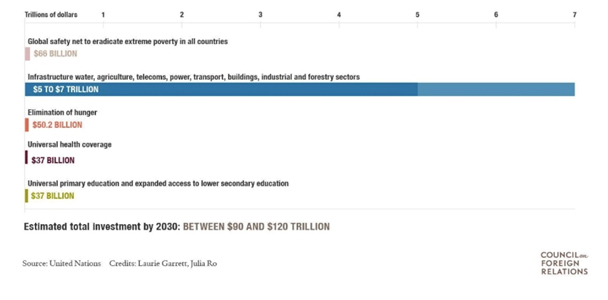
Let us forget the damage for a moment to think about business. Could the American President, who likes to exalt the sovereignty of the United States, be tempted by the tremendous volume of business that constitutes the achievement of the SDGs by the 2030 deadline? His first speech to the United Nations, held on 19 September, leaves no indication of any interest in this type of global challenge. However, the volume of business generated by the SDGs could be tempting. As shown in the following diagram[3], the estimated investment amount for the UN 2030 program is US $ 90-120 trillion.


blog-4-a


Coordination

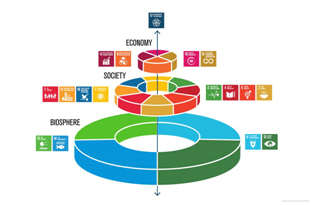
On 5 October, at the Lausanne seminar “Achieving SDGs through sport”, organized by the Swiss authorities, I mentioned a possible coordination of investments so that the international sports community collectively assumes Article 37 on the contribution of sport to SDGs[4]. I recalled the approach we had taken during the MDG era. By developing public-private partnerships in areas such as water infrastructure, agriculture, telecommunications, power, transports, buildings, industrial and forestry sectors, representing a volume of $ 66 billion, it is possible to finance universal health coverage - 37 billion US dollars - universal primary education and increased access to lower secondary education - 37 billion US dollars. I also showed that this coordination between SDGs and their funding could open new avenues to the financing of youth sport. We will return to this in the following episodes, drawing inspiration from some of the SDG's perspectives. That supplied by ECOHZ and the illustration of J. Lokrantz for Nitrogen put us on the way[5].


blog-4-b
75%

Helen Clark allows us to measure the magnitude of the task. From April 2009 to April 2017, Helen Clark served as Administrator of the United Nations Development Program. She was the first woman to assume the leadership of the organization. She also served as the Chair of the United Nations Development Group. It is a committee that brings together the directors of all the funds, programs and departments specifically responsible for development issues. In 2015, when the 2030 program was voted, the UNDP official said that more than US $ 3 300 billion a year would be needed to implement the MDGs. We would have to beat the world record of investment. Indeed, the sum invested in 2014 for sustainable development was only 135 billion. But where can we find the remaining 75%?

Transition

They are to be found in the contribution of all stakeholders, be they States, companies or foundations. On the planet, we all row in the same boat, one beside the other. That said, there are disputes. We are now all forced to adopt the same vision of the future, included in the same global and multidimensional ecosystem, with its ecological, geopolitical, economic and social valences. Indeed, it is the great innovation initiated by the SDGs. In 2015, a journalist summed up the transition made possible by the 2030 program: "It marks the transition from goals for others (MDG targets to developing countries) to goals for all (SDGs)”[6].

Fallow

The MDGs launched in 2000 had the merit of providing a global framework for the international community to work on these development issues. As we have said, they had left fallow the issue of inequality, which concerns both North-South inequalities, but also inequalities within countries. Some regions of the world had been left out of development: this was the case in Africa, but also in South-East Asia. Unlike the MDGs, SDGs are universal, which will force all countries around the world to participate and ask how to achieve these goals. Indeed! How? Let us take an example of universal scope, in the sense that it concerns the totality of the women and men of this planet.

Forests

One of the seventeen (17) SDGs interests each creature at the highest level. Even the American President, his five (5) children and eight (8) grandchildren, even his typical voter, this religious white American, over 45 years old, living in a small or medium-sized city, of $ 50,000 a year, are very much concerned. This is the fifteenth ODD: Sustainable forest management, combating desertification, halting and reversing the process of land degradation and halting the loss of biodiversity.

Green

A few sentences will suffice to recall the stakes of the achievement of this SDG. Terrestrial vegetation plays a crucial role in climate change. Deforestation contributes to the increase in temperature. The role of forests is crucial to limiting greenhouse gas emissions. Forests absorb and store CO2, each year the forests absorb nine (9) million tons, ie 20% of CO2 emissions. One billion six hundred million people live in and from the forest. The disappearance of forests is programmed if nothing is done. The United Nations and the nations are mobilized. In 2014, the summit on deforestation. In 2015, the Paris agreements. Governments, businesses and indigenous communities decide on common objectives.

Oxygen

Reduce deforestation by 50% by 2020 and halt it by 2030 and aim for resilience to CO2. Since 2011, the World Bank has spent 10 billion US dollars combatting deforestation. Comprehensive resilience to CO2 involves spending several hundred billion dollars. At least 1000 billion US dollars a year by 2050. The public sector is not able to finance this. Private sector engagement is essential. This entails the need to create the necessary tools to raise funds. Somehow green US banknotes to save the green of the planet. If the reduction in CO2 is essential for the planet to continue to breathe, oxygen is essential for everyone's breathing. The transition is easy, you will think! This brings us back to the oxygen necessary for the sport of youth. And if we were inspired by processes designed to be resilient to CO2 to generate money that could develop youth sport so that it could breathe better. Forests, physical education, youth sport? Who will pay?


Next: Monday, October 30, 2017 - Transforming the world: detour by Lausanne

[1]UNESCO (2017), L’éducation en vue des objectifs de développement durable : objectifs d’apprentissage, ISBN 978-92-3-200116-0, page 10.

[2]Jeune Afrique (2017), En 2100, 74% de la population mondiale risquent de mourir de chaud, 23 juin 2017 à 13h05 — updated 23 June 2017 at 15h15, by Élodie Descamps.
[3]United Nations, Council on Foreign Relations, Credits Laurie Garett, Julia Ro, cited by Eisenstat, A. et Traub, D. The Future of Impact Investing: Funding Social Innovation
for Sustainable Development,in CSR Index 2017, Edited by:
Matthias Vollbracht & Roland Schatz page 61.
[4]Coordination that would involve collegial governance of the Sport for Development and Peace sector on which we will come back.
[5]ECOHZ,https://www.ecohz.com, particularlyhttp://bit.ly/2xyaI5A

[6]Libération (2015), L'ONU adopte un programme pour changer de monde, by Clarisse Chick (http://www.liberation.fr/auteur/15874-clarisse-chick) — 25 September 2015 at 19:07